

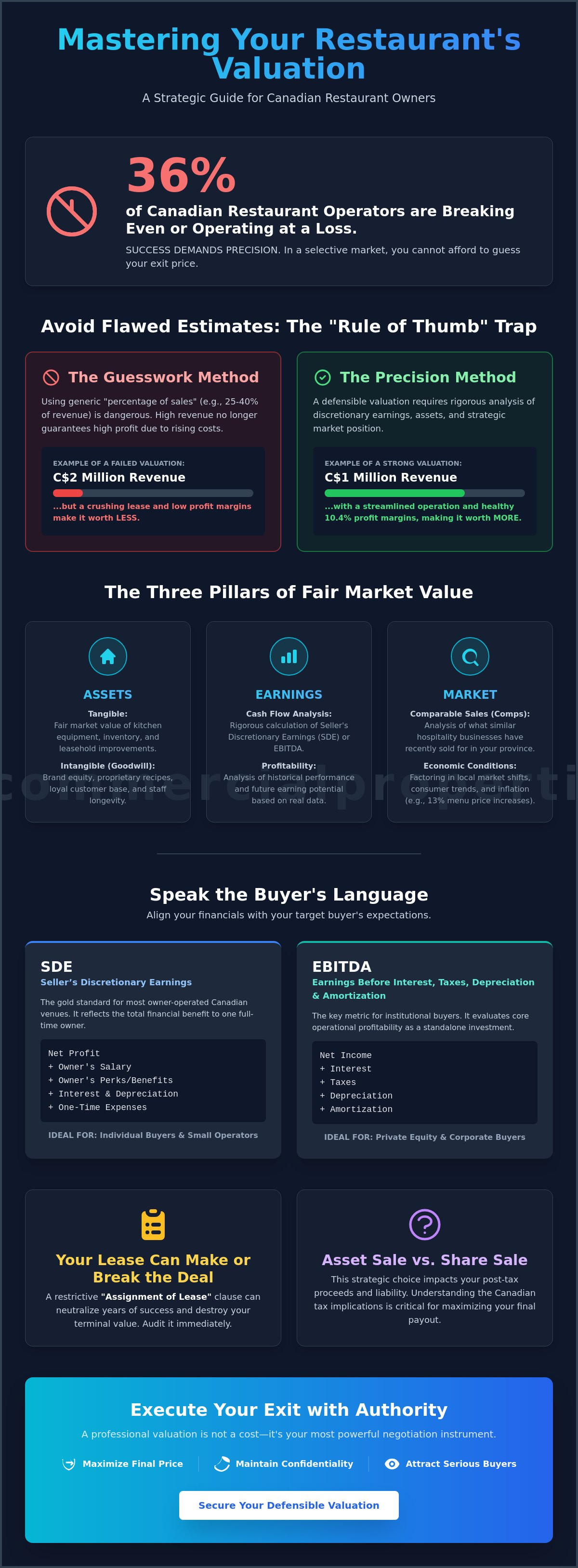
The true value of your Canadian restaurant isn't found in your kitchen; it's buried in your lease and your discretionary cash flow. SUCCESS DEMANDS PRECISION. With 36% of restaurant operators currently breaking even or operating at a loss according to Restaurants Canada data, you cannot afford to guess when determining your exit price. You've spent years building your brand, yet the fear of leaving money on the table or miscalculating "goodwill" often leads to stalled deals. Learning how to value a restaurant for sale requires more than a simple revenue multiple; it demands a rigorous analysis of your discretionary earnings and the strategic positioning of your commercial assets.
You likely realize that a defensible valuation is the only way to secure a serious buyer in 2026's selective market. We'll show you exactly how to master the financial and legal frameworks needed to determine your business's true market worth while maximizing your final sale price. This guide breaks down the shift from SDE to EBITDA multiples, the critical impact of your lease terms on total value, and the tax implications of asset versus share sales under current Canadian regulations. It's time to transform your hospitality legacy into a high-value commercial exit.
Key Takeaways
- ALIGN YOUR FINANCIALS. Distinguish between Seller’s Discretionary Earnings (SDE) and EBITDA to ensure your reporting matches the specific expectations of your target buyer profile.
- QUANTIFY YOUR GOODWILL. Master the rigorous multi-step process of how to value a restaurant for sale by synthesizing tangible asset appraisals with the intangible strength of your brand.
- SECURE THE LEASE. Audit your "Assignment of Lease" clauses immediately; a restrictive commercial agreement can effectively neutralize years of operational success and destroy your terminal value.
- STRUCTURE FOR SUCCESS. Navigate the strategic divide between asset and share sales to maximize your post-tax proceeds while mitigating the risk of inherited liabilities during the transaction.
- NEGOTIATE WITH AUTHORITY. Utilize professional valuation reports as high-leverage negotiation instruments to maintain absolute confidentiality and command a premium market exit.
Understanding the Fundamental Pillars of Restaurant Valuation
PRECISION IS POWER. Determining how to value a restaurant for sale is not a simple exercise in accounting; it's a strategic synthesis of tangible physical assets and the intangible potential for future earnings. In the Canadian commercial landscape, we operate under the standard of Fair Market Value (FMV). This is defined as the highest price, expressed in Canadian Dollars, that a property would bring in an open and unrestricted market between a willing buyer and a willing seller who are both knowledgeable and acting at arm's length. To reach this figure, we must look beyond the balance sheet and analyze the Fundamental Pillars of Restaurant Valuation, which balance historical performance against the volatile economic projections of 2026.
Valuation is a discipline where art meets science. The science lies in the rigorous application of financial formulas, while the art involves interpreting how local market shifts and consumer trends impact your specific brand. With real commercial foodservice sales expected to decline by 0.2% in 2026 when adjusted for inflation, your valuation must be defensible and rooted in reality. You cannot rely on outdated figures from 2019. We weigh your historical data against current pressures, such as the 13% average increase in menu prices seen across the industry, to ensure your asking price reflects the modern Canadian hospitality environment.
The Three-Legged Stool: Assets, Earnings, and Market
- Tangible Assets: This includes the fair market value of your kitchen equipment, inventory, and leasehold improvements. In a high-inflation environment, the replacement cost of these items has surged, making an accurate inventory audit essential for a strong valuation.
- Intangible Assets: Your brand equity, proprietary recipes, and the longevity of your core staff create "goodwill." These factors are what transform a collection of stoves and tables into a profitable enterprise.
- Market Comps: Analyzing recent national and local sales is non-negotiable. We look at what similar hospitality businesses in your specific province have actually fetched, providing a grounded benchmark for your expectations.
Why "Rule of Thumb" Estimates Often Fail
Generic formulas are dangerous. Many amateur sellers attempt to use a simple "percentage of sales" method, often citing figures like 25% to 40% of annual revenue as a standard. This is a recipe for disaster in 2026. Because 71% of operators reported significant menu price hikes to offset rising food and labour costs, high revenue no longer guarantees high profit. A restaurant with C$2 million in sales but a crushing lease and inefficient labour model is worth far less than a streamlined C$1 million operation with healthy 10.4% profit margins.
Algorithms and generic calculators miss the nuances of your specific location and operational efficiency. Knowing how to value a restaurant for sale requires a professional eye that can identify hidden value in your lease terms or the strategic advantage of your liquor license. We don't just look at what you've done; we identify the untapped potential that a buyer will pay a premium to acquire. Trusting a specialized hospitality broker ensures you aren't leaving money on the table due to a flawed, surface-level calculation.
Calculating Value Using Financial Multiples: SDE vs. EBITDA
DATA DRIVES THE DEAL. When mastering how to value a restaurant for sale, you must first identify which mathematical lens your buyer is using. For most owner-operated Canadian venues, Seller’s Discretionary Earnings (SDE) is the gold standard. It represents the total financial benefit a single owner-operator takes from the business, including net profit, their own salary, and various "add-backs." Conversely, institutional buyers and private equity firms focus on EBITDA. This metric strips away interest, taxes, depreciation, and amortization to evaluate the business's core operational profitability as a standalone entity. Understanding this distinction is vital because it dictates the final number on your valuation report.
The choice between these two methods fundamentally shifts the multiple applied to your earnings. SDE typically yields a lower multiple because it includes the owner's "job" as part of the earnings. EBITDA multiples are usually higher because they reflect a managed investment where the leadership is already paid as an expense. According to recent data on financial multiples for Canadian restaurants, the 2026 market is seeing valuations range from 1.5x to 4.0x. Smaller, owner-dependent cafes often sit at the lower end, while established, multi-unit brands with resilient 10.4% profit margins command the ceiling. If you're ready to see where your business sits in this range, our specialists in Restaurant and Hospitality Sales can provide a preliminary assessment.
Mastering the SDE Recasting Process
Recasting is the process of revealing the true profit available to a new owner. This involves identifying legitimate "add-backs" that won't necessarily be expenses for the next person. Think of personal vehicle leases, one-time equipment repairs, or discretionary travel. If your bookkeeping isn't meticulous, these numbers won't hold up under professional scrutiny. You need clear proof to justify every dollar added back to the bottom line. Credibility is your greatest currency during the due diligence phase.
The Multiple Variance: What Scales Your Price Up?
Why does one bistro get a 2.0x multiple while another gets 3.5x? It comes down to risk and transferability. A business that fails when the owner goes on vacation is a high-risk asset with a low multiple. Buyers pay a premium for systems. If you've automated your inventory with AI "smart kitchen" tools or have a long-term management team in place, your transferability score sky-rockets. Scalability is the final piece of the puzzle. A concept that can be easily replicated in another Canadian province will always attract a more aggressive multiple than a location-bound "hidden gem." Knowing how to value a restaurant for sale means understanding how to de-risk the investment for the person sitting across the table.
Beyond the Ledger: How Leases and Liquor Licenses Drive Price
LEASES ARE THE LIFEBLOOD OF HOSPITALITY. You can have the most profitable kitchen in the country, but if your lease is expiring in eighteen months with no option to renew, your business has near-zero terminal value. When sophisticated buyers investigate how to value a restaurant for sale, they look past the decor and straight at the head lease. A weak contract doesn't just lower the price; it kills the deal entirely. We focus on the "Assignment of Lease" clause because it determines whether you can actually transfer your success to a successor. If a landlord can veto a buyer or force a rent reset, your hard-earned equity is at their mercy.
Intangible regulatory assets often provide the "floor" for your valuation in competitive urban centres. A transferable liquor licence is a massive strategic advantage that saves a buyer months of red tape, community hearings, and lost revenue. In high-density areas, "grandfathered" permits for specific uses or late-night hours are worth their weight in gold because new zoning laws often prevent competitors from obtaining similar rights. Given the pressures of high operating costs and shifting consumer habits, Executing the Exit requires a deep understanding of these hidden assets to justify a premium asking price.
The Commercial Lease: Your Most Valuable Contract
- Term and Renewal: A buyer needs at least five to ten years of secured term to amortize their investment. Each remaining year on a favourable lease acts as a multiplier boost to your final valuation.
- The Demolition Clause: This is a silent valuation killer. If a landlord can terminate your lease for redevelopment with six months' notice, your business value effectively evaporates because the buyer has no long-term security.
- Triple Net (NNN) Realities: We analyze the stability of your Additional Rent. Unpredictable spikes in property taxes or maintenance can erode the net cash flow that supports your valuation.
Licensing and Regulatory Assets
Beyond the liquor licence, we evaluate the "hidden debt" of compliance. If your kitchen equipment or ventilation isn't up to 2026 building codes, a buyer will deduct the cost of those upgrades from your price. Conversely, a permanent patio permit is a significant revenue driver that adds tangible value to the earnings multiple. Knowing how to value a restaurant for sale means quantifying the time and capital a buyer saves by stepping into a fully compliant, licensed, and permitted operation. We ensure these advantages are clearly documented and defended during negotiations.
Asset Sale vs. Share Sale: Navigating the Canadian Transactional Landscape
STRUCTURE DICTATES PROFIT. When you determine how to value a restaurant for sale, the final figure on the valuation report is only half the battle. The legal structure of your transaction will decide how much of that value stays in your bank account after the Canada Revenue Agency takes its cut. In an asset sale, you're selling the "stuff": the equipment, the leasehold improvements, and the goodwill. In a share sale, you're selling the entire corporation itself. This distinction is the primary point of friction in Canadian hospitality deals because what benefits the buyer almost always creates a tax burden for the seller.
STRATEGY IS NON-NEGOTIABLE. While most small to mid-sized deals start as asset sales for simplicity, larger institutional transactions often lean toward share structures. We often see "Hybrid Sales" emerge as a middle ground for complex hospitality deals, where the parties attempt to balance tax exemptions with liability protection. Understanding how to value a restaurant for sale in Canada requires this high-level grasp of transactional law. You don't just need a price; you need a deal structure that protects your legacy and your capital.
The Buyer’s Perspective: Mitigating Risk
BUYERS CRAVE CLEAN BREAKS. From a buyer's standpoint, an asset sale is almost always the preferred path because it allows them to leave your corporate history and potential liabilities behind. By purchasing the assets directly, a buyer avoids successor liability for unpaid GST/HST, provincial health tax arrears, or pending employment litigation. They also benefit from a "stepped-up" basis; they can begin depreciating the kitchen equipment and furniture at the new purchase price rather than continuing with your old book values. If you're looking to expand your portfolio through Investment Property Acquisition, understanding these tax shields is essential for calculating your true return on investment.
The Seller’s Perspective: Maximizing Net Proceeds
SELLERS VOTE FOR SHARES. The $1M+ Lifetime Capital Gains Exemption (LCGE) is the ultimate prize for Canadian restaurant owners. If your business qualifies as a Canadian-Controlled Private Corporation, selling your shares could allow you to realize a massive portion of your gain tax-free. Conversely, an asset sale often triggers a "recapture" of previously claimed depreciation, which is taxed as regular income rather than at the 50% capital gains inclusion rate. We work to negotiate the "Allocation of Purchase Price" meticulously, ensuring that the value assigned to equipment versus goodwill satisfies both parties while minimizing your tax sting.
Executing the Exit: Why Professional Valuation is Your Strategic Advantage
VALUATION IS A WEAPON. A professional appraisal is not merely a static number on a page; it's a defensible strategic asset that dictates the tempo of your negotiation. In the selective market of 2026, where 36% of Canadian restaurant operators are breaking even or facing losses according to Restaurants Canada, buyers are scrutinizing every line item with unprecedented intensity. Knowing how to value a restaurant for sale allows you to enter the room with absolute confidence, backed by a report that justifies your "goodwill" and tangible assets through rigorous financial proof. We don't just find a price. We build a narrative of value that survives the most aggressive due diligence process.
STRATEGIC POSITIONING COMMANDS PREMIUMS. Beyond the math, your exit strategy depends on the expertise of a specialized hospitality broker who understands the nuances of the Canadian market. We ensure that your deal structure remains robust, addressing potential friction points like lease assignments or liquor license transfers before they become deal-breakers. By aligning your financial reporting with the expectations of sophisticated investors, we transform your years of hard work into a liquid asset. This is about more than a transaction; it's about a dedicated lifestyle reaching its most profitable conclusion.
The Power of Confidentiality in Hospitality Sales
CONFIDENTIALITY IS YOUR CURRENCY. The moment a public listing alerts your staff or loyal customers to an impending exit, your business value begins to bleed. High staff turnover and customer uncertainty can erode the very profit margins you're trying to sell. We utilize "blind profiles" to vet qualified investors, ensuring that only those with the financial capability and professional intent see the specifics of your operation. We act as the buffer in high-stakes negotiations, protecting your brand's reputation while we source the right successor.
Your Blueprint for a Successful Closing
- The Due Diligence Package: You must organize three years of P&Ls and corporate tax returns to provide a transparent history of your earnings.
- Asset Appraisals: Addressing leasehold improvements and equipment valuations early prevents last-minute "price chipping" from buyers during the inspection phase.
- Legal Cleanliness: Ensure all health permits and building code requirements are current to avoid inheriting "hidden debt" at the closing table.
RESULTS REQUIRE PREPARATION. A successful closing is the product of meticulous organization and professional advocacy. It's time to secure your legacy with a comprehensive hospitality valuation from Grace Yan Global Commercial Agent. By mastering how to value a restaurant for sale today, you ensure a prosperous and clean transition that reflects the true worth of your hospitality career.
Secure Your Hospitality Legacy
PRECISION IS YOUR GREATEST ALLY. You've built your brand through years of dedication; now it's time to ensure your exit reflects that effort. Mastering how to value a restaurant for sale requires a meticulous synthesis of your discretionary earnings and the strategic security of your commercial lease. We've explored how recasting your financials and leveraging Canadian tax structures like the Lifetime Capital Gains Exemption can drastically shift your net proceeds. In a market where 36% of operators are merely breaking even, a defensible valuation is the only way to command the premium your hard work deserves.
With over 20 years of combined legal and real estate expertise, I bring the precision of a former Paralegal and Notary Public to every hospitality transaction. My focus on specialized franchise resales and complex hospitality negotiations ensures your business is positioned for maximum market impact and a seamless closing. Don't leave your equity to chance or flawed algorithms. Book a Strategic Valuation Consultation with Grace Yan today to transform your professional success into a landmark commercial exit. Your next chapter starts with an authoritative strategy.
Frequently Asked Questions
What is the most common multiple for a restaurant in Canada?
Financial multiples for Canadian restaurants in 2026 typically range between 1.5x and 4.0x of earnings. Smaller owner-operated venues usually trade at the lower end of this spectrum, while established brands with resilient 10.4% profit margins command the higher ceiling. The specific multiple depends on your operational systems, brand strength, and the remaining term on your commercial lease.
How do I value my restaurant if it is currently losing money?
If your business is currently operating at a loss, you must pivot to an asset-based valuation approach rather than an earnings multiple. This method calculates how to value a restaurant for sale by totaling the fair market value of your kitchen equipment, leasehold improvements, and transferable permits. Even without profit, a prime location with a long-term lease and a liquor license holds significant "key money" value for a buyer.
Does the value of the real estate get included in the restaurant sale price?
Real estate is almost always valued and sold as a separate asset from the hospitality business itself. While a "turnkey" deal including the building exists, most transactions involve a business sale paired with a new or assigned commercial lease. If you own the property, you must decide whether to sell the real estate through a commercial property sale or retain it to become your buyer's landlord.
How much does a professional restaurant valuation cost?
The cost of a professional restaurant valuation depends on the complexity of your financial recasting and the depth of the required appraisal. Because every hospitality operation has unique variables, such as "grandfathered" permits or complex "Assignment of Lease" clauses, you should consult with a specialized broker to determine the scope of work needed. A rigorous report is a strategic investment that prevents leaving equity on the table during how to value a restaurant for sale discussions.
Can I sell my restaurant if the landlord refuses to assign the lease?
Selling a restaurant becomes nearly impossible if the landlord refuses to assign the lease, as the leasehold interest is the foundation of the business's value. Sophisticated buyers won't close a deal without secured tenure and clear renewal options. You must review your "Assignment" clause immediately to ensure the landlord cannot "unreasonably withhold" consent to a qualified successor who meets the original financial requirements.
What is the difference between SDE and EBITDA in the hospitality industry?
SDE is the total benefit to a single owner-operator, while EBITDA measures the core profitability for institutional investors. SDE includes your salary and personal add-backs, making it the standard for small to mid-sized Canadian venues. Institutional buyers prefer EBITDA because it treats management as an expense, providing a clearer picture of the restaurant's performance as a standalone investment without the original owner's involvement.
How does a liquor license affect the final sale price?
A transferable liquor license adds a significant premium to your final sale price by saving the buyer months of regulatory red tape and community hearings. In high-density urban centres, these permits are often "grandfathered" under older zoning laws, making them irreplaceable assets. We quantify this value by analyzing the cost of acquisition and the immediate revenue potential the license provides to a new operator on day one.
Should I include my inventory in the asking price?
Inventory is typically excluded from the initial asking price and is calculated separately as "Stock at Valuation" (SAV) just before the closing date. This ensures the buyer pays only for the fresh product and usable supplies actually on hand at the moment of transfer. Including a fixed inventory amount in the primary asking price often leads to disputes if stock levels fluctuate during the due diligence period.