

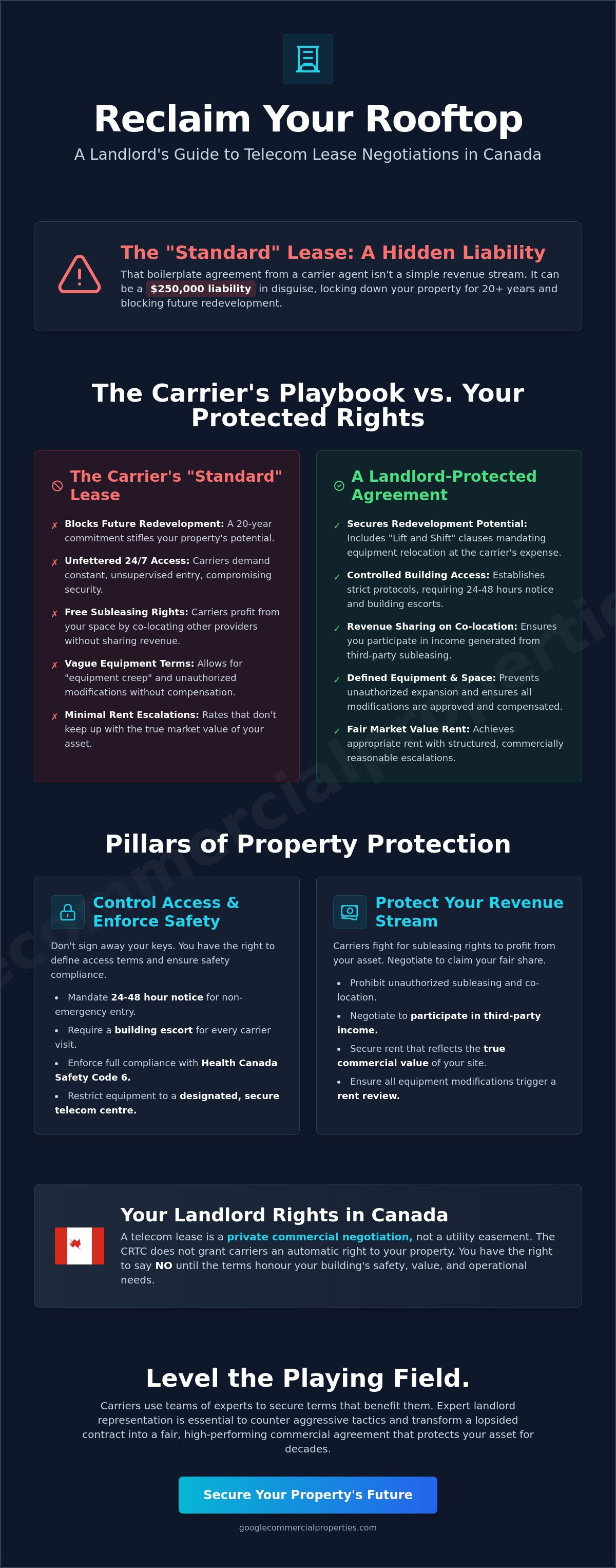
What if the "standard" agreement sitting on your desk is actually a $250,000 liability disguised as a steady revenue stream? You aren't alone if you feel bullied by carrier agents who treat their boilerplate terms as non-negotiable; many owners worry that a 20-year commitment will block future redevelopment or saddle them with hidden liabilities. Asserting your landlord rights telecom lease protections is the only way to reclaim the narrative and ensure your building remains under your control. You deserve to realize the full potential of your property without being sidelined by "take-it-or-leave-it" offers that prioritize corporate network expansion over your asset's long-term health.
It's frustrating to watch carriers push for lower annual escalations while they aggressively modify equipment on your rooftop without offering a fair share of the value. This strategic guide reveals the essential landlord rights telecom lease legal and commercial levers you must exercise to prevent telecom carriers from compromising your property value. We will examine how to navigate these complex negotiations and secure terms that protect your long-term interests. From managing equipment density to ensuring your right to redevelop remains intact, you'll learn how to transform a passive lease into a controlled, high-performing investment by mastering every landlord rights telecom lease opportunity available to you.
Key Takeaways
- Realize that a telecom lease is a long-term encumbrance on your property title and learn why "standard" carrier agreements are designed to minimize your operational control.
- Assert your landlord rights telecom lease protections by establishing strict protocols for building access and ensuring total compliance with Health Canada Safety Code 6.
- Protect your revenue streams by identifying why carriers fight for subleasing rights and how you can negotiate to participate in the income from third-party co-location.
- Secure your property’s future redevelopment potential through "Lift and Shift" clauses that mandate equipment relocation at the carrier’s expense for building repairs.
- Understand why expert landlord representation from a seasoned commercial advocate is essential to levelling the playing field against aggressive carrier negotiation tactics.
Understanding Landlord Rights in Telecom Leases: Beyond the Standard Agreement
YOUR PROPERTY IS NOT A UTILITY POLE. A telecom lease is a significant, long-term encumbrance on your property title that can dictate the future of your asset for twenty years or more. Carriers often frame these agreements as simple, passive income streams, but they're complex legal instruments that can stifle your ability to sell or redevelop. Exercising your landlord rights telecom lease protections is the only way to ensure your property remains under your control. You have an inherent right to professional representation and to demand rent that reflects the actual commercial value of your site. Treating this as a mere transaction is a mistake; it's a high-stakes negotiation where your asset’s longevity is the prize. To gain a broader perspective on the industry, Understanding Telecommunications Leases offers a neutral overview of how these arrangements impact various property types.
The Illusion of the 'Standard' Contract
Carriers love templates. They use standardized contracts to bake in their own protections while minimizing yours. These documents are designed to fast-track carrier goals, often including "boilerplate" traps that restrict building access or limit your right to relocate equipment. You don't have to accept these terms. You have the power to strike out clauses that compromise your building's core or rooftop. Specialized advisors identify these hidden risks, turning a lopsided contract into a fair commercial deal. Never let a carrier's "standard" process dictate your property's future. You must realize that every line item is a point of leverage that can either protect or devalue your investment over the next two decades.
National Regulatory Context in Canada
The Canadian regulatory environment is often misunderstood by property owners. While the CRTC oversees the industry, they don't give carriers an automatic right to your rooftop. A commercial telecom lease is not the same as a utility easement for a power line; it's a private commercial negotiation. You have no obligation to grant access without an agreement that satisfies your safety, financial, and operational requirements. Carriers must respect your private property rights, and you should never feel pressured to sign under the guise of regulatory necessity. You have the right to say no until the terms honour the true value and safety of your building. Understanding this distinction is the first step in reclaiming your authority as a landlord.
The Pillars of Property Protection: Access, Safety, and Interference
PROTECTION IS NOT OPTIONAL. It's the foundation of maintaining your building's long-term integrity. When you exercise your landlord rights telecom lease protections, you're setting the boundaries of a multi-decade partnership that must respect your asset's physical limits. Carriers often assume they have a right to roam your rooftop at will; however, your priority is the safety of your building's core and the comfort of your existing tenants. Every modification requested by a carrier, whether it's part of a massive 5G rollout or a hardware swap, must be backed by a clear commitment to bear all structural reinforcement costs. This isn't just about rent. It's about ensuring your asset isn't compromised by heavy steel frames or intrusive cabling that could lead to leaks and structural fatigue.
Managing Physical and Technical Access
DON'T SIGN AWAY YOUR KEYS. A common carrier tactic involves demanding 24/7 unfettered access to the premises. You have the right to define "Reasonable Notice" for entry, typically requiring 24 to 48 hours for non-emergency maintenance. Insist on a building escort during every visit to ensure no unauthorized modifications occur. By mandating that all equipment stays within a designated, secure "telecom centre" or specific rooftop zone, you prevent "equipment creep" that could interfere with other tenants or future rooftop amenities. If you're concerned about how current installations are impacting your space, it's wise to seek expert landlord representation to audit your site's physical boundaries.
Radio Frequency (RF) and Structural Integrity
Safety is a non-negotiable pillar of property ownership. Your lease must mandate strict, ongoing compliance with Health Canada Safety Code 6 to protect everyone on-site from radio frequency exposure. Before a single bolt is turned, demand an independent engineering review of the carrier's plans, fully paid for by the carrier. This ensures your roof membrane and structural slabs can actually handle the load of modern arrays. Interference is defined as both physical blockage of access paths and electronic signal disruption of building systems. While negotiating subleasing rights is vital for revenue, these technical protections are what keep your building standing. Robust indemnification clauses must shield you from any structural damage or liability caused by the carrier's heavy equipment or installation errors. You have the right to demand that your property remains as safe and sound as the day the lease was signed.
Subleasing and Co-location: Protecting Your Revenue Stream
YOUR ROOFTOP IS NOT A FREE-FOR-ALL. Carriers view your property as a strategic hub for their network, and they often attempt to act as a "master tenant" by subleasing space to their competitors. This process, known as co-location, allows them to generate significant revenue from your asset while paying you nothing extra. Without specific landlord rights telecom lease protections, you might find your roof crowded with third-party hardware that you never approved. You have a fundamental right to participate in the revenue generated by every piece of equipment on your building. If a carrier profits from your real estate by bringing in a sub-tenant, you deserve a substantial percentage of that income. Never grant absolute subleasing freedom; it's your property, and you should be the one profiting from its expansion.
The Hidden Value of Co-location
One antenna can quickly turn into four. Carriers often use "optimization" as a pretext to add more hardware, but if your rights are weak, this equipment might belong to a completely different provider. You should always maintain the strategic advantage of requiring a separate lease or a formal amendment for each new sub-tenant. This ensures that the structural and power capacity of your building is never exceeded by a "silent" expansion. Structuring a revenue-sharing clause is the only way to ensure you're compensated for the increased density. While you navigate these negotiations, understanding the broader regulatory framework, such as the FCC Rules for Telecom Providers, can provide valuable context on how service providers are permitted to interact with property owners in multi-tenant environments.
Maintaining Control Over Your Tenant Mix
You have the right to say no. "Reasonable Consent" is a powerful tool that allows you to vet every sub-tenant before they set foot on your property. You should never allow a carrier to sublease to a provider that competes with your existing commercial tenants or compromises the building's aesthetic. Administrative consent is a trap; it's often framed as a simple notification, but for complex telecom installations, you need full approval rights. Protecting the "colour" and character of your building means limiting equipment density to what you find acceptable. By asserting your authority early, you ensure that your property remains a premium asset rather than a cluttered utility site. Don't let a carrier's desire for a quick co-location deal dictate the long-term value of your commercial investment.
Preserving Future Asset Value: Relocation and Restoration Rights
PROTECT YOUR EXIT STRATEGY. A telecom lease should never be a cage that prevents you from selling or redeveloping your property. While the immediate revenue is attractive, you must realize that a 20-year commitment can severely impact your asset's liquidity if your landlord rights telecom lease protections are weak. If a potential buyer sees that a carrier has an ironclad right to occupy the roof without any possibility of relocation, they may walk away from the deal. You need the absolute right to move that equipment at the carrier's sole expense whenever building repairs, roof replacements, or major redevelopments are necessary. This is about maintaining the agility of your investment over the long haul.
The Critical Relocation Clause
Building maintenance is inevitable. Over a two-decade span, you will almost certainly need to replace your roof membrane or perform structural work. A "Lift and Shift" clause is vital; it mandates that the carrier temporarily moves their arrays so your contractors can work safely and effectively. You should negotiate a specific notice period, such as 60 or 90 days, for non-emergency moves, while ensuring the carrier remains responsible for all costs associated with the temporary relocation. Don't let a carrier's hardware become a permanent obstacle to your building's evolution. If you are planning a significant capital project, securing expert telecom lease representation ensures your relocation rights are enforceable and commercially sound.
End-of-Lease Restoration Requirements
What happens in 2046? The cost to remove heavy steel mounts and specialized cabling decades from now will be significantly higher than today's rates. You must secure a removal bond or a letter of credit to ensure the equipment isn't simply abandoned when technology shifts. Restoration must be defined strictly to include the professional repair of all roof penetrations and structural alterations made during the term. Demand that "as-built" drawings are updated and handed over at the end of the term so you have an accurate record of your building's condition. You may also want to retain certain infrastructure, such as conduit, if it adds utility for future tenants. Carriers must provide a certified environmental assessment upon site decommissioning to prove no hazardous materials were left behind. By being thorough now, you protect the next generation of your property's value.
Leveling the Playing Field: The Case for Expert Landlord Representation
EXPERTISE IS YOUR GREATEST LEVERAGE. While a lawyer can review the fine print of a contract, legal expertise alone is rarely enough to maximize the commercial potential of your rooftop. You need a dedicated advocate who understands the nuances of the telecom market and the specific motivations driving carrier behaviour. Grace Yan brings a unique, high-octane background to the table as a former paralegal and a seasoned commercial broker, offering a blend of technical precision and assertive negotiation skills. This "solution-first" mindset allows her to take a carrier's aggressive equipment modification request and transform it into a strategic opportunity for rent increases or better site protections. By exercising your landlord rights telecom lease interests through professional representation, you ensure that every deal pays for itself through higher revenue and significantly lower long-term risk.
The Power of Sophisticated Negotiation
Moving from "standard" to "superior" terms requires a methodical approach to deal structuring that most landlords simply don't have the time to master. Carriers employ entire teams of specialists to minimize their costs; you deserve a fierce advocate who can counter-balance that pressure with deep-rooted industry knowledge. Leveraging a global reach and cross-border investment perspective is essential for understanding why a carrier might be desperate for your specific location. When you have an expert who can read between the lines of a proposal, you move from a position of uncertainty to one of absolute dominance. It's about more than just checking boxes. It's about creating a narrative of value that forces the carrier to respect your property's worth.
Your Next Steps to Secure Your Property
Don't wait for a crisis to review your terms. A comprehensive lease audit is the most critical step you can take before signing any renewal or modification agreement. Carriers often rely on "boilerplate" traps to slide through unfavourable conditions, but a specialized advisor can identify these risks before they become liabilities that stall a future sale. You have the right to demand a contract that protects your asset's future as much as it provides current income. If you want to ensure your building remains a high-performing investment rather than a carrier's playground, take action now. Contact Grace Yan today for a strategic review of your telecom lease and start protecting your property with the authority it deserves.
Take Command of Your Telecom Strategy
Your property is a premium asset that deserves absolute protection; it's time to stop accepting lopsided carrier terms as inevitable. By asserting your landlord rights telecom lease protections, you reclaim control over building access, safety protocols, and the lucrative potential of co-location revenue. You now understand how a well-structured "Lift and Shift" clause preserves your future redevelopment options, while strict restoration requirements ensure your building's integrity remains intact for decades to come. These are not just legal details; they are the strategic levers that determine the long-term liquidity and value of your commercial investment.
Success in these high-stakes negotiations requires more than just a signature on a boilerplate page. Grace Yan provides authoritative representation for commercial landlords across Canada, bringing over 20 years of legal and real estate expertise to every deal. She specializes in complex telecom infrastructure negotiations, ensuring you aren't just a site on a map but a dominant partner in a profitable arrangement. Secure your property's future, let Grace Yan negotiate your telecom lease. You have the power to transform a standard agreement into a strategic victory that secures your legacy. Your asset is in good hands.
Frequently Asked Questions
Can I refuse to renew a telecom lease if I want to redevelop my property?
Yes, you can refuse to renew or even terminate an agreement early if you have a specific redevelopment or "demolition" clause negotiated into your contract. Without this protection, a carrier's long-term rights can block your project for decades, effectively holding your property title hostage. You should ensure your agreement includes a clear termination right for major renovation or redevelopment, typically requiring a set notice period to allow the carrier to find an alternative site.
How much should I charge for a rooftop antenna lease in Canada?
Rooftop lease rates in Canada vary significantly based on location and specific network demand within a "search ring." In major metropolitan centres, it is possible to secure $2,500 per month or more for a prime rooftop site, while rural ground leases might average closer to $1,300 per month as of 2026. Every site is unique; you should avoid relying on national averages and instead seek a market valuation that reflects the specific technical necessity of your building to the carrier's grid.
What happens if the carrier abandons their equipment on my roof?
If a carrier abandons equipment, your primary protection is a removal bond or a letter of credit established at the start of the term. These financial instruments ensure funds are available for decommissioning even if the carrier becomes insolvent or simply walks away from the site. Your contract must define "abandonment" clearly and mandate full restoration of the premises to its original condition, including the professional sealing of all roof penetrations and structural repairs.
Do I need a lawyer or a specialized broker for telecom lease negotiations?
You ideally need both, but a specialized broker is essential for understanding the commercial market value and aggressive carrier tactics. While a lawyer ensures legal compliance, a broker specializing in landlord rights telecom lease representation understands current rental rates and technical requirements that a generalist might miss. This dual approach ensures your agreement is both legally sound and commercially lucrative, protecting you from "take-it-or-leave-it" boilerplate offers.
Can a telecom carrier install 5G equipment without my consent?
A carrier generally cannot install 5G equipment without your consent if the new hardware exceeds the physical or technical specifications outlined in your existing agreement. Most 5G upgrades involve significant weight increases or different antenna arrays, which trigger the need for a formal lease amendment. You should use these modification requests as leverage to renegotiate outdated terms or increase your monthly rent to reflect the increased utility of your space.
What is a 'Lift and Shift' clause and why is it non-negotiable for landlords?
A 'Lift and Shift' clause is a vital provision that allows you to temporarily move carrier equipment at their sole expense for building maintenance. This is critical for roof membrane replacements or structural repairs that will inevitably occur during a 20-year term. Without this clause, you could be held liable for interfering with their signal, even if your building is suffering from urgent leaks that require immediate contractor access.
How does a telecom lease affect the sale price of my commercial building?
A telecom lease can be a double-edged sword for your building's valuation. While the steady revenue stream can increase your capitalization rate, poorly drafted terms that lack relocation rights or include hidden liabilities can deter sophisticated buyers and lower your final sale price. Ensuring your landlord rights telecom lease protections are robust makes your property more attractive to investors who value both consistent income and total operational flexibility.
Who is responsible for the electricity costs of the telecom equipment?
The carrier is almost always responsible for their own electricity costs. You should mandate the installation of a separate utility meter or a sub-meter to ensure you aren't subsidizing their high-power hardware. If a sub-meter is used, your lease should include a specific administrative fee for processing the billing and ensuring the carrier pays for the exact kilowatt-hours consumed by their equipment, preventing any leakage of your building's net operating income.