
A poorly executed deal structure is a silent predator that will erode your capital long before the first lease payment arrives. In a market where C$1.8 trillion in commercial loans are maturing throughout 2026, the margin for error has vanished. You already recognize that finding the right asset is only the beginning; the real victory lies in structuring a commercial real estate purchase that shields you from the hidden liabilities and complex tax implications that frequently derail mid-market acquisitions. We operate with a solution-first mindset to ensure these obstacles become opportunities for strategic growth.
This article serves as your definitive blueprint for mastering the sophisticated deal structures used by elite investors to mitigate risk and maximize asset value across the Canadian landscape. You will learn to navigate the nuances of the One, Big, Beautiful Bill Act and its impact on 100 percent bonus depreciation while securing your interests against negotiation fatigue. We will provide the exact framework needed to draft a bulletproof Letter of Intent and select a tax-efficient ownership entity that aligns with your long-term goals. Expect a clear, methodical roadmap for closing that ensures your investment remains secure and your professional legacy continues to expand.
Key Takeaways
- Master Deal Architecture: Learn why the intentional arrangement of legal and financial components is far more critical to your long-term success than the final purchase price.
- Optimize Tax Efficiency: Discover how to isolate liability through single-purpose entities and Canadian ownership vehicles to prevent catastrophic financial leaks.
- Layer Protective Contingencies: Implement robust "Subject To" clauses within your LOI to turn the due diligence period into a powerful shield for your investment capital.
- Leverage the Capital Stack: Gain a strategic edge in structuring a commercial real estate purchase by balancing traditional senior debt with vendor take-backs and mezzanine financing.
- Secure the Strategic Advantage: Understand how a fierce advocate navigates the final Agreement of Purchase and Sale to resolve closing hurdles before they compromise the transaction.
Mastering Deal Architecture: More Than Just a Purchase Price
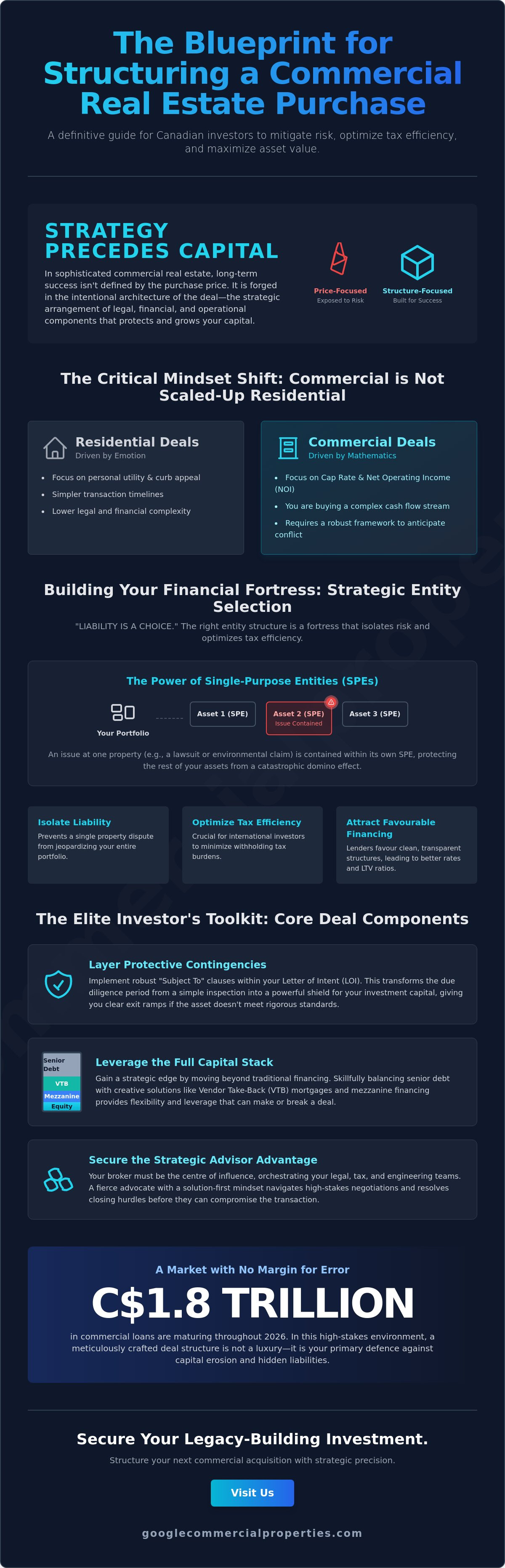
STRATEGY PRECEDES CAPITAL. In the sophisticated world of Canadian investment, success isn't defined by the price you pay; it's defined by the framework you build. When structuring a commercial real estate purchase, you are engaging in a tactical exercise that balances legal protection, financial leverage, and operational fluidity. Many investors make the fatal mistake of treating a commercial deal like a scaled-up residential transaction. This "one-size-fits-all" mentality is exactly how catastrophic tax leaks and liability exposures happen. If your ownership structure isn't designed to isolate risk from the start, one tenant dispute or environmental oversight can jeopardize your entire portfolio.
Every decision you make during the initial design phase must align with your long-term exit strategy. Whether you intend to hold the asset for generational wealth or execute a five-year value-add play, your structure dictates your eventual liquidity. We utilize a methodology known as "Strategic Deal Flow." This approach ensures that every Commercial property acquisition is vetted through a rigorous filter of risk mitigation and value maximization. By the time you sign the Agreement of Purchase and Sale, every contingency should be a calculated step toward your desired outcome.
The Difference Between Residential and Commercial Structuring
RESIDENTIAL IS EMOTIONAL; COMMERCIAL IS MATHEMATICAL. While a home purchase focuses on personal utility and curb appeal, a commercial acquisition lives and dies by the Cap Rate and Net Operating Income (NOI). You aren't just buying bricks and mortar; you're buying a cash flow stream. This shift in perspective requires a much higher level of due diligence. Multi-tenant assets introduce layers of complexity, such as staggered lease expirations, common area maintenance (CAM) reconciliations, and tenant improvement obligations. Because these variables are so volatile, commercial timelines require a more robust legal framework. You need a contract that anticipates conflict rather than one that merely hopes for a smooth closing.
The Role of the Strategic Advisor in Deal Design
YOUR BROKER MUST BE THE CENTRE OF INFLUENCE. A top-tier advisor doesn't just find a building; they orchestrate the entire professional team. We act as the primary hub connecting your legal counsel, tax accountants, and environmental engineers to ensure no detail is overlooked. My background allows for a unique, legal-adjacent perspective that prevents "contractual blindness." This is the ability to spot hidden traps in a lease or purchase agreement before they become expensive realities. We don't just identify problems; we bring an assertive, solution-first mindset to the table. When structuring a commercial real estate purchase, you need a fierce advocate who can navigate high-stakes negotiations and engineer a path forward when others see a dead end. This level of precision is what separates a standard transaction from a legacy-building investment.
Entity Selection: Protecting Assets and Optimizing Tax Efficiency
LIABILITY IS A CHOICE. Choosing the wrong vehicle when structuring a commercial real estate purchase is a mistake that can haunt your balance sheet for decades. In the Canadian market, your entity choice isn't just a legal formality; it's a strategic fortress. We prioritize isolating liability through Single-Purpose Entities (SPEs). This ensures that a localized issue at one property, such as an environmental claim or a slip-and-fall lawsuit, doesn't trigger a domino effect across your entire portfolio. For our international clients, this selection becomes even more critical. It dictates how capital flows back across borders while minimizing the friction of withholding tax burdens.
Lenders scrutinize your entity as much as they evaluate the asset itself. A clean, transparent structure makes you a lower-risk borrower, which often translates into more favourable interest rates and higher Loan-to-Value ratios. If you plan on refinancing in three to five years to pull equity for your next acquisition, the groundwork must be laid today. A fragmented or poorly documented ownership structure will lead to delays or outright rejections during the underwriting process. Precision at the start ensures liquidity at the finish.
Corporations vs. Limited Partnerships (LPs)
CORPORATIONS PROVIDE STABILITY. Using a Canadian corporation is the standard for many long-term holders due to the clear separation of personal and business assets. However, sophisticated investors often prefer Limited Partnerships. LPs are powerful because they allow for flow-through tax benefits. This means that certain losses or depreciation can be passed directly to the partners to offset other income, making it a highly efficient vehicle for high-net-worth groups. While LPs require more rigorous administrative maintenance and annual filings, the tax advantages often outweigh the paperwork. If you are looking to build a high-performance portfolio, you might want to explore our investment property acquisition services to see how we align these structures with specific asset classes.
The Strategic Use of Bare Trusts and Nominee Corporations
PRIVACY IS A STRATEGIC ASSET. In institutional-grade acquisitions, we frequently utilize Bare Trusts and Nominee Corporations to separate legal title from beneficial ownership. A nominee corporation holds the title on paper, while the Bare Trust agreement outlines who actually controls the rights and receives the income from the property. This is a common Canadian alternative to the American guide to setting up a real estate LLC in terms of asset protection. This structure is particularly effective for maintaining privacy and facilitating future transfers of interest without triggering immediate land transfer taxes. In many provinces, transferring the beneficial interest rather than the registered title can save hundreds of thousands of dollars in closing costs. We identify when this structure is mandatory to ensure your acquisition remains competitive and confidential.
The Due Diligence Template: Layering Protective Contingencies
REVEAL THE TRUTH BEFORE YOU COMMIT. The due diligence period is the most volatile and critical phase when structuring a commercial real estate purchase. It's the moment where the polished marketing brochure meets the cold reality of the property's history. We view this phase as a tactical window to layer protective contingencies that ensure you aren't inheriting a previous owner's negligence. A solution-first mindset is essential here. We don't just identify problems; we engineer the repairs or price adjustments needed to keep the deal viable. Every Letter of Intent (LOI) must include non-negotiable "Subject To" clauses covering financing, environmental assessments, and comprehensive physical inspections.
No acquisition is complete without a thorough Phase I Environmental Site Assessment. If any red flags appear, you must proceed to a Phase II study immediately. Ignoring potential soil contamination or hazardous materials can lead to environmental liabilities that far exceed the property's value. While some international investors look toward programs like SBA 504 loans for commercial real estate as a benchmark for fixed-asset financing in the south, Canadian investors must ensure their contingencies align with local lender requirements and provincial environmental regulations. We ensure your due diligence period is long enough to perform these deep-tissue investigations without being rushed by a motivated seller.
Financial and Operational Verification
NUMBERS DON'T LIE, BUT THEY CAN HIDE. You must verify the rent roll with absolute precision by cross-referencing it with bank deposits and tenant estoppels. We look specifically for "hidden" concessions, such as two months of free rent buried in a side agreement, or pending tenant defaults that haven't been disclosed. Analyzing the Trailing 12 months (T-12) of operating expenses is equally vital to ensure the Net Operating Income hasn't been artificially inflated by deferring maintenance. Reviewing existing service contracts is another area where value is often lost. We scrutinize telecom, waste, and maintenance obligations to determine if these contracts can be optimized or if they represent a long-term drain on your cash flow. If you're dealing with complex Investment Property Acquisition, these operational details become the foundation of your future profitability.
Physical and Legal Scrutiny
ZONING IS DESTINY. You must confirm that your intended use of the property is permitted by the municipality. Never assume that the current use is legal; non-conforming uses can be terminated by the city at any time. A comprehensive title search is required to identify restrictive covenants or easements that could limit your ability to redevelop or expand the site. Finally, a Building Condition Assessment (BCA) provides the data needed to anticipate major Capital Expenditures (CapEx) for the next decade. Knowing that the HVAC system or the roof will require replacement in year three allows you to structure the purchase price to reflect those upcoming costs. This level of scrutiny ensures you are buying an asset, not a liability.
Financing the Stack: Leveraging Debt and Vendor Take-Backs
CAPITAL IS A TOOL, NOT A CRUTCH. In the current Canadian market, traditional bank lending is merely the baseline for structuring a commercial real estate purchase. High-tier investors don't just look for a mortgage; they construct a "Capital Stack" that balances senior debt with mezzanine financing or private equity to optimize their internal rate of return (IRR). As of May 2026, conventional commercial mortgage rates have stabilized between 5.43 percent and 8.84 percent. While these rates are more predictable than the volatility of previous years, relying solely on a single lender often leaves too much equity trapped on the sidelines. We focus on building a structure that remains cash flow positive even under stress tests that account for potential vacancy spikes or future rate hikes.
The 2026 interest rate cycle, with the federal funds rate holding between 3.50 percent and 3.75 percent, has created a unique environment for acquisitions. With approximately C$1.8 trillion in commercial loans maturing this year, motivated sellers are more common than they have been in a decade. This creates a prime opportunity to utilize creative financing layers that traditional institutions might overlook. If you are ready to expand your portfolio, you can explore our commercial property sales and investment acquisition services to identify assets where these complex financing strategies can be deployed for maximum effect.
The Vendor Take-Back (VTB) Mortgage Strategy
THE SELLER BECOMES THE PARTNER. A Vendor Take-Back (VTB) mortgage is a powerful instrument that bridges the gap between your down payment, your primary loan, and the total purchase price. In this scenario, the seller agrees to lend a portion of the purchase price back to you, often at a competitive interest rate. Sellers are frequently incentivized to do this because it allows them to defer capital gains taxes over several years rather than taking a massive tax hit in the year of the sale. When we structure these, we ensure the VTB terms are strictly subordinate to your primary lender. This keeps your senior creditor satisfied while reducing the initial cash outlay required to close the deal.
Optimizing for Refinancing and Equity Harvests
PLAN YOUR EXIT BEFORE YOU ENTER. Every acquisition should be structured with an eye toward a "Value-Add" refinance within three to five years. This allows you to harvest your initial equity once the property's Net Operating Income has increased. However, you must be vigilant regarding "Prepayment Penalties" and "Yield Maintenance" clauses in your initial loan documents. These legal hurdles can make a refinance prohibitively expensive if they aren't negotiated upfront. We organize your deal structure to ensure maximum flexibility, allowing you to pull capital out and redeploy it into new assets without being strangled by restrictive exit fees. Precision in your loan documents today ensures liquidity for your next major move tomorrow.
Finalizing the Transaction: The Strategic Advisor Advantage
THE FINISH LINE OFTEN PRESENTS THE HIGHEST RISK TO YOUR CAPITAL. While the previous phases of your acquisition focused on discovery and leverage, the final execution of the Agreement of Purchase and Sale (APS) is where the theoretical becomes binding. Structuring a commercial real estate purchase involves a continuous refinement of terms that doesn't conclude until the title transfer is complete and the funds are fully registered. You require a fierce advocate to ensure that closing day hurdles, such as insurance gaps or minor title clouds, are resolved with a solution-first mindset rather than becoming deal-ending obstacles. We drive the process with absolute confidence to prevent negotiation fatigue from eroding the value you've meticulously built through earlier stages of the deal.
The Transition from LOI to APS
THE SPIRIT OF THE DEAL MUST SURVIVE THE LEGAL DRAFTING PROCESS. It's common for "Deal Breaker" clauses to emerge in the final hour as opposing counsel attempts to shift risk back to the buyer through complex indemnity language. We prioritize the verification of Estoppel Certificates from existing tenants to ensure the pro forma you relied upon remains accurate on day one. These certificates are the final line of defence against undisclosed disputes or rental concessions that could impact your Net Operating Income post-closing. By ensuring every operational detail and tenant obligation is codified in the APS, we secure the asset's performance from the moment you take possession. This methodical approach ensures that the protective contingencies layered during due diligence are fully enforceable in the final contract.
Your Global Partner in Canadian Commercial Real Estate
Grace Yan Global Commercial Agent provides a sophisticated blend of 20+ years of legal and real estate expertise to bridge the gap between complex contracts and market reality. My background as a former paralegal and notary public allows for a level of precision that prevents "contractual blindness" during the final signature phase, ensuring that every comma and clause serves your long-term interests. We operate as a high-octane global partner for strategic asset acquisition, utilizing deep cross-border connections to facilitate high-stakes transactions across the Canadian landscape. This brand persona is defined by a tireless work ethic and a belief that professional service is a calling rather than a job. Book Your Strategic Acquisition Consultation with Grace Yan Global Commercial Agent. You are putting your capital in the hands of a seasoned veteran who acts as both a fierce advocate and a steady hand, ensuring your investment remains bulletproof and your professional legacy continues to expand.
Engineering Your Legacy Through Strategic Acquisition
SUCCESS IS THE RESULT OF PRECISION. You've moved beyond the surface-level metrics of price to understand that the true value of an investment is secured through the meticulous layers of your deal architecture. By isolating liability via strategic entity selection and leveraging creative financing tools like the Vendor Take-Back, you transform a standard transaction into a high-performance asset. You now possess the blueprint to ensure rigorous due diligence and a bulletproof Letter of Intent serve as your primary shields against the hidden liabilities that frequently derail less-prepared investors.
Mastering the art of structuring a commercial real estate purchase requires a blend of legal foresight and market intuition that few possess. With over 20 years of industry expertise and a background as a Former Paralegal and Notary Public, Grace Yan Global Commercial Agent provides the solution-first advocacy needed to navigate the procedural complexities of the Canadian landscape. This global investment perspective ensures your portfolio expansion is both strategic and seamless. Book Your Strategic Acquisition Consultation with Grace Yan Global Commercial Agent. Your next major acquisition deserves the steady hand of a seasoned veteran who treats your success as a calling. Let's build your commercial future together.
Frequently Asked Questions
What is the most common mistake when structuring a commercial real estate purchase?
The most common mistake when structuring a commercial real estate purchase is treating the legal entity as an afterthought rather than a primary defensive shield. Investors often rush into an Agreement of Purchase and Sale in their personal name or an existing operating company, which exposes their entire portfolio to unnecessary liability. This lack of foresight often results in expensive rectification costs later or catastrophic tax leaks that could have been avoided with a dedicated Single-Purpose Entity.
How long does a typical commercial real estate closing take in Canada?
A typical commercial closing in Canada takes between 60 and 120 days. This timeline accounts for a 30 to 90-day due diligence period followed by a final 30-day period for the legal transfer of funds and title. Complex transactions involving rezoning or environmental remediation can extend this window significantly. We drive this process methodically to ensure every milestone is met without compromising the thoroughness of your investigation.
Can I use a Vendor Take-Back (VTB) for any type of commercial property?
You can utilize a VTB for any commercial asset class provided the seller is willing to participate in the financing. While they are frequent in high-value acquisitions or sales where traditional lenders are cautious, VTBs are versatile tools for bridging the capital gap in industrial, retail, or hospitality assets. The key is to structure the terms so they remain subordinate to your primary lender while offering the seller a compelling tax deferral advantage.
Is it better to buy commercial property in a personal name or a corporation?
It is almost always superior to acquire commercial property through a corporation or a limited partnership. Corporate ownership provides a critical layer of liability protection that isolates the asset from your personal wealth and other business interests. Additionally, corporations offer significant tax planning advantages, such as the ability to control the timing of income distributions and access lower corporate tax rates on active business income.
What is a Bare Trust and why do investors use them for property acquisitions?
A Bare Trust is a legal arrangement where a nominee corporation holds the registered title to a property while the beneficial owner retains all rights and responsibilities. Investors use this structure to maintain privacy and facilitate the transfer of beneficial interest without triggering immediate land transfer taxes in certain jurisdictions. It is a sophisticated tool for institutional-grade acquisitions where confidentiality and future flexibility are paramount.
How does a Phase I Environmental Assessment impact my deal structure?
A Phase I Environmental Assessment acts as a primary risk-mitigation trigger within your due diligence framework. If the report identifies potential contamination, the deal structure must pivot to include a Phase II investigation or a firm contingency for seller-led remediation. We use these findings to renegotiate the purchase price or adjust the closing timeline, ensuring you never inherit an environmental liability that could bankrupt the project.
What are the typical closing costs for a commercial property in Canada?
Typical closing costs for a Canadian commercial transaction range from 1 percent to 5 percent of the purchase price. These costs include provincial land transfer taxes, legal fees, and due diligence expenses such as appraisals and building condition assessments. You should also budget for loan origination fees, which typically range from 0.5 percent to 1 percent of the mortgage amount. We provide a detailed breakdown early in the process to ensure your capital stack is fully funded.
How do I protect my deposit if the due diligence reveals major building defects?
You protect your deposit by ensuring your Agreement of Purchase and Sale contains explicit, non-negotiable "Subject To" clauses. These contingencies must state that the deposit is fully refundable if the physical, financial, or environmental condition of the property is not to your sole and absolute satisfaction. By establishing these legal guardrails at the Letter of Intent stage, you maintain the leverage needed to walk away from a defective asset with your capital intact.