
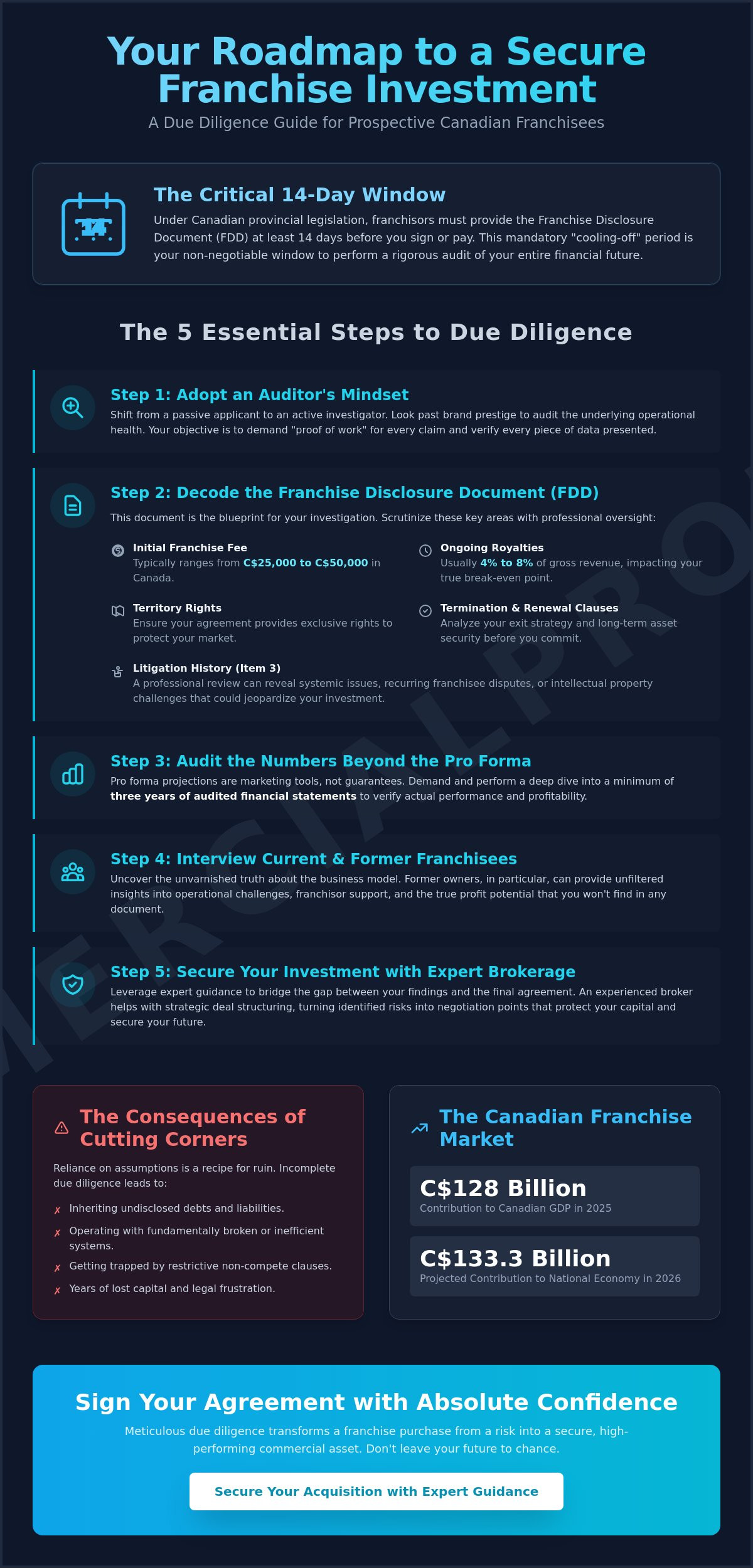
YOUR ENTIRE FINANCIAL FUTURE IS DECIDED IN A FOURTEEN DAY WINDOW. While the Canadian franchise industry is projected to contribute C$133.3 billion to the national economy in 2026, many prospective owners feel paralyzed by the complexity of legal disclosures and the fear of hidden liabilities. You've likely felt that same uncertainty while staring at a dense Franchise Disclosure Document, wondering if the projected profit margins are as robust as they appear. Performing comprehensive due diligence for buying a franchise is not just a recommendation; it's a rigorous audit of your future lifestyle and a necessary shield for your hard earned capital.
I will show you how to master the essential steps to audit any opportunity so you can sign your agreement with absolute confidence. This article provides a clear roadmap for investigating financial viability and understanding the provincial regulations and overarching legal framework that applies to franchise agreements across Canada. We'll explore how to mitigate risk through strategic investigation and professional oversight, ensuring you realize the true potential of your commercial investment.
Key Takeaways
- VERIFY THE MECHANICS. Look past brand prestige to audit the underlying operational health of the business before committing your capital.
- MASTER THE FDD. Understand how provincial legislation and the "14-Day Rule" provide a critical window for a comprehensive legal and financial review.
- AUDIT THE NUMBERS. Realize that pro forma projections are not guarantees and require a deep dive into three years of audited financial statements.
- UNCOVER THE TRUTH. Execute thorough due diligence for buying a franchise by questioning former owners to reveal the unvarnished reality of the business model.
- SECURE YOUR ASSETS. Leverage expert brokerage to bridge the gap between disclosure findings and strategic deal structuring for a secure acquisition.
The Critical Role of Due Diligence in Canadian Franchising
SUCCESS IS NOT AN ACCIDENT. It is the result of meticulous scrutiny and an uncompromising refusal to accept surface-level presentations as fact. In a market where the franchise industry contributed C$128 billion to the Canadian GDP in 2025, the stakes for entry are incredibly high. Effective due diligence for buying a franchise is the systematic process of verifying every claim made by a franchisor, from their operational support claims to their actual financial health. You must look past the vibrant branding and the prestige of a national name to analyze the underlying mechanics that determine whether a business will thrive or fail in your specific Canadian territory.
This investigation serves as your primary shield against predatory contracts and pro formas that may have been inflated to secure a sale. By adopting a solution-first approach, you aren't just buying a job; you're securing your family’s financial future through a calculated acquisition of a commercial asset. You must treat every document, particularly the Franchise Disclosure Document (FDD), as a piece of evidence in a broader audit of the franchisor’s long-term viability. Protecting your capital requires a level of intensity that goes beyond standard industry research.
The Consequences of Cutting Corners
RELIANCE ON ASSUMPTIONS IS A RECIPE FOR RUIN. Skipping deep-level research often leads to inheriting undisclosed debts or operational systems that are fundamentally broken. Many prospective owners fall into restrictive non-compete traps because they didn't scrutinize the fine print of their agreements during the initial investigation. The cost of learning the hard way in the commercial world is measured in lost capital and years of legal frustration. Without professional guidance and a disciplined investigative process, you risk signing away your autonomy for a business model that cannot deliver the promised returns in the current economic climate.
The Authoritative Mindset: Audit, Don’t Just Ask
BECOME THE AUDITOR. Shift your mindset from a passive seeker to an active investigator who demands "proof of work" for every success claim. If a franchisor boasts about high profit margins, you must demand the audited financial statements that verify those numbers across multiple units. This authoritative stance allows you to identify weaknesses early, which then informs your strategic deal structuring. When you uncover risks during the due diligence for buying a franchise phase, you gain the leverage necessary to negotiate terms that protect your interests, turning a standard transaction into a secure, high-performing investment.
Decoding the Franchise Disclosure Document (FDD)
THE BLUEPRINT FOR YOUR EMPIRE LIES WITHIN THE DISCLOSURE. In the Canadian market, the Franchise Disclosure Document (FDD) is the most significant instrument in your acquisition journey. It provides a comprehensive window into the franchisor’s operational history, financial stability, and legal standing. Under provincial legislation like Ontario’s Arthur Wishart Act or British Columbia’s Franchises Act, franchisors must deliver this document at least 14 days before you sign any agreement or pay any consideration. This "14-Day Rule" is your mandatory cooling-off and investigation period. Performing rigorous due diligence for buying a franchise requires you to utilize every second of this window to verify the franchisor’s claims against the foundational standards for due diligence in Canadian franchising.
EXAMINE THE LITIGATION HISTORY WITH UNWAVERING SCRUTINY. A professional review of Item 3 in the FDD can reveal systemic issues, such as recurring disputes with franchisees or intellectual property challenges that could jeopardize your investment. You must also distinguish between the initial franchise fee, which typically ranges from C$25,000 to C$50,000 in Canada, and the ongoing royalty structures that usually demand 4% to 8% of gross revenue. Understanding these obligations is vital for calculating your true break-even point. If the numbers seem opaque, consider consulting an expert in franchise resale services to identify these red flags early in the process.
Key Clauses That Require Legal-Adjacent Scrutiny
PROTECT YOUR EXIT BEFORE YOU ENTER. Termination and Renewal clauses must be analyzed to ensure your asset remains secure beyond the initial term. You cannot afford to ignore Territory Rights; without exclusive boundaries, a franchisor could saturate your local market and cannibalize your sales. Scrutinize Transfer Restrictions as well. These clauses often dictate how and to whom you can sell your business, potentially hindering your eventual exit strategy and the liquidity of your commercial asset.
The Importance of Rescission Rights in Canada
RESCISSION IS THE ULTIMATE REMEDY. In Canada, if a franchisor fails to provide a compliant FDD or if the document contains material deficiencies, you may have the right to rescind the agreement. This "divorce-level" remedy allows you to unwind the deal and potentially recover your entire investment. While you have 60 days for late delivery and up to two years for non-delivery, relying on rescission is a high-stakes legal battle. Your goal should be to avoid this scenario entirely by engaging an expert guide to identify disclosure gaps before a single dollar of your capital is committed.
Financial and Operational Audit: Beyond the Pro Forma
PRO FORMAS ARE FICTION. They represent a hypothetical "best-case" scenario designed to market a dream, yet many buyers treat them as guaranteed results. Comprehensive due diligence for buying a franchise requires you to strip away the optimism and perform a methodical search for the break-even reality. You must demand and audit the franchisor’s audited financial statements for the last three years to verify their corporate health and the sustainability of their revenue streams. A franchisor that cannot demonstrate consistent profitability at the corporate level is a liability you cannot afford to ignore.
IDENTIFY THE SILENT PROFIT KILLERS. Beyond initial fees, you must account for mandatory contributions to national marketing funds, which typically range from 1% to 3% of gross sales according to Canadian industry standards. These costs, combined with ongoing royalty fees of 4% to 8%, can rapidly erode your margins if your operational volume isn't sufficient. Your audit must be clinical; you are looking for the point where the business stops costing you money and starts generating wealth. Every percentage point matters when you are protecting your capital.
The Lease and Location Audit
THE LEASE IS YOUR MOST DANGEROUS CONTRACT. While you focus on the franchise agreement, the commercial lease often carries higher risk. If your lease term doesn't align with your franchise duration, or if it lacks a Right of First Refusal, your property rights are vulnerable. Utilizing professional Commercial Leasing Services ensures that your location remains a secure asset. You must verify that the lease terms support the business model rather than acting as a predatory drain on your resources. Expert landlord representation is a necessity, not a luxury.
Supply Chain and Procurement Realities
CONTROL YOUR COSTS OR THEY WILL CONTROL YOU. You must investigate whether the franchisor forces you to purchase supplies at a markup from their preferred Canadian distribution network. Reliability is vital in our market; a failure in the supply chain can halt your operations overnight. Determine if the "rebates" from vendors are funneled back to the franchisor or shared with the franchisees. Transparency in procurement is the only way to ensure your margins remain protected from corporate greed and operational inefficiency.
The Human Element: Interviewing Current and Former Franchisees
DATA IS ONLY HALF THE STORY. While financial audits reveal the past, the human element predicts your future. Performing due diligence for buying a franchise must include direct, unscripted conversations with those currently in the trenches and those who have already exited the system. You need the unvarnished truth about the daily grind, the actual level of head office support, and the cultural alignment of the brand. If the franchisor’s values don't match your personal work ethic, the most profitable pro forma won't save you from eventual burnout. You are auditing a relationship, not just a balance sheet.
BEWARE THE POLISHED NARRATIVE. Most franchisors provide a validation list of successful owners during the disclosure phase. Treat these with extreme caution; they often act as shills, delivering rehearsed praise to ensure the system continues to expand. To find the real story, you must seek out former franchisees. They are no longer bound by the need to protect the brand's reputation and are far more likely to disclose the systemic failures or hidden costs that led to their departure. If you are looking for a transparent entry into the market, our franchise resale services can help you navigate these complex interpersonal dynamics and identify the true history of a specific location.
Questions for Current Franchise Owners
DO NOT SETTLE FOR VAGUE ANSWERS. Force the conversation into concrete territory with targeted inquiries that strip away the marketing gloss. You must ask if the franchisor actually delivers the operational support they promised during the sales pitch or if you are left to struggle alone when a crisis hits. Demand to know how long it truly took them to reach a consistent break-even point in their specific Canadian territory. Finally, ask what the one thing is they wish they knew about the royalty structure or supply chain before they signed their agreement.
Investigating the "Why" Behind Departures
PATTERNS REVEAL THE TRUTH. When you analyze former owners, look for a recurring theme in their exits to determine the health of the system. Were they pushed out by predatory capital expenditure requirements, or did they sell for a high-yield profit after a successful ten-year run? If you find a cluster of owners leaving within the first 24 months, you are likely looking at a sinking ship. Use this data as leverage to negotiate better terms or to walk away before your capital is at risk. Successful due diligence for buying a franchise is a methodical audit of the franchisor’s character and their commitment to your success.
Securing Your Investment with Expert Brokerage and Strategy
ELIMINATE UNCERTAINTY THROUGH EXECUTION. You have audited the disclosure documents, scrutinized the three year financial history, and interviewed the operators in the field. However, identifying a risk is only half the battle; the final phase of your acquisition requires translating those findings into a binding agreement that protects your capital. Effective due diligence for buying a franchise reveals the obstacles, but strategic brokerage is what eliminates them. Grace Yan Global Commercial Agent operates as a global investment advisor, bridging the gap between sophisticated administrative analysis and high stakes real estate negotiation to ensure your transition into ownership is seamless and secure.
STRATEGIC DEAL STRUCTURING IS YOUR FINAL SHIELD. If your investigation uncovered deferred maintenance, declining local traffic, or restrictive lease terms, the purchase price and transfer agreement must reflect those realities. We utilize a solution-first mindset to frame these obstacles as opportunities for price adjustment or improved lease conditions. By navigating national franchise resales with a veteran’s perspective, we ensure that you move from a cautious investor to a decisive owner with absolute confidence in the long term viability of your commercial asset. You deserve a partner who views professional service as a calling and possesses the diverse skill set required to dominate this complex industry.
The Power of Professional Representation
THE ADVANTAGE OF A FIERCE ADVOCATE. With over 20 years of deep rooted expertise in the Canadian commercial landscape, our firm manages the intricate transfer process between the franchisor, the seller, and you. This tripartite relationship is fraught with potential delays and administrative hurdles that can derail an acquisition. As your representative, we act as the steady hand that coordinates Franchise Resale Services with precision, ensuring every provincial regulation is met and every disclosure gap is closed. Having a seasoned veteran in your corner during negotiations provides the leverage needed to secure a deal that favours your growth rather than just the franchisor’s expansion.
Your Next Step: The Solution-First Consultation
TRANSFORM YOUR VISION INTO REALITY. The path to successful ownership is paved with disciplined research and expert oversight. We invite you to reach out for a comprehensive review of your specific franchise opportunity to ensure no liability remains hidden. In a high stakes commercial environment, you need a partner who values transparency and provides "proof of work" through a proven track record of successful acquisitions. Take the definitive step toward securing your financial future and realize the potential of a well vetted investment. Secure your franchise investment with expert guidance today.
DOMINATE YOUR MARKET ENTRY
YOU ARE NOW EQUIPPED WITH THE TOOLS FOR VICTORY. By dismantling the franchisor’s sales pitch and verifying the underlying operational truth, you've moved from a passive candidate to a sophisticated investor. You understand that true asset security comes from scrutinizing every clause in the FDD and realizing that financial pro formas are merely starting points for a deeper audit. Exhaustive due diligence for buying a franchise is the only way to ensure your capital is protected against systemic risks and hidden liabilities within the Canadian market.
TRANSFORM YOUR VISION INTO A TANGIBLE ASSET. With over 20 years of legal and commercial real estate expertise, Grace Yan provides the solution-first mindset necessary for national Canadian investors to navigate complex franchise transfer negotiations with absolute precision. You don't have to face these high stakes decisions alone when you can have a fierce advocate and a steady hand in your corner. Take the final step toward ownership with a partner who treats your success as a professional calling. Partner with Grace Yan for Expert Franchise Due Diligence today and start your journey with the confidence that only deep rooted expertise can provide.
Frequently Asked Questions
Is the Franchise Disclosure Document (FDD) legally binding in all Canadian provinces?
FRANCHISE LEGISLATION IS PROVINCIAL. Currently, only seven provinces have specific franchise disclosure laws: Alberta, British Columbia, Manitoba, New Brunswick, Ontario, Prince Edward Island, and Saskatchewan. While the Saskatchewan Franchise Disclosure Act comes into force on June 30, 2026, provinces without legislation still rely on common law principles of "good faith" and traditional contract law to govern these commercial relationships.
How long does the due diligence process typically take for a franchise purchase?
EXPECT A TIMELINE OF 30 TO 90 DAYS. While the mandatory 14-day cooling-off period is the minimum legal requirement, a professional audit of historical financials and franchisee interviews requires more time. You must ensure every operational claim is verified and every lease term is aligned before you commit your capital to a long-term agreement.
Can I negotiate the terms of a standard franchise agreement in Canada?
EVERYTHING IS NEGOTIABLE FOR THE RIGHT CANDIDATE. While franchisors often present their agreements as "take it or leave it" documents, strategic due diligence for buying a franchise often reveals leverage points. You can frequently negotiate territory protections, transfer fees, or renewal conditions if you present a professional case backed by market data and a solution-first approach.
What are the most common red flags to watch for in a franchisor’s financial statements?
WATCH FOR REVENUE IMBALANCE. A major red flag is a franchisor that generates the majority of its income from initial franchise fees rather than ongoing royalties. This suggests the brand is focused on aggressive sales rather than supporting existing owners. You should also scrutinize high litigation costs and any significant year-over-year decline in corporate net worth or cash reserves.
Do I need a separate lawyer if I am already working with a commercial real estate broker?
YES, SPECIALIZATION IS VITAL. A commercial broker manages the market analysis, location acquisition, and strategic deal structuring, while a franchise lawyer focuses on the legal compliance of the FDD and the binding nature of the contract. You need both a fierce advocate for the real estate and a steady hand for the legal review to ensure your investment is fully protected.
What happens if the franchisor fails to provide the FDD within the 14-day window?
YOU GAIN THE POWER TO RESCIND. If a franchisor fails to deliver the FDD at least 14 days before signing or payment, or if the document is materially deficient, you have the legal right to unwind the deal. This rescission right can extend up to two years if no FDD was provided, potentially allowing you to recover your initial investment and operational losses.
How does the commercial lease tie into the franchise agreement?
THEY ARE INTERDEPENDENT ASSETS. If your commercial lease expires before your franchise term, or if the landlord can terminate the lease because of a franchise default, your business is vulnerable. You must ensure your lease terms allow for the specific use required by the brand and that you have the right to transfer the lease if you eventually sell your franchise.
Is it better to buy a new franchise territory or an existing franchise resale?
RESALES PROVIDE PROOF OF WORK. Buying an existing location allows for more concrete due diligence for buying a franchise because you can audit actual historical performance rather than projections. New territories offer growth potential but carry higher risk. Resales often involve complex negotiations regarding equipment condition and existing staff, making expert brokerage a necessity for a clean transfer.