
A Triple Net Lease isn't merely a rental agreement. It's a high-stakes strategic risk-transfer mechanism that can either solidify your portfolio's longevity or bury your margins in unforeseen liabilities. You already know that commercial real estate offers unparalleled stability, yet the fear of hidden maintenance costs or the complexity of Canadian property tax assessments often creates unnecessary hesitation. In a market where commercial properties are taxed at rates averaging 2.65 times higher than residential ones, precision is your only protection.
Mastering the nuances of understanding triple net leases allows you to transform from a cautious participant into a seasoned strategist capable of insulating your capital. This guide provides an exhaustive breakdown of the "three nets" and compares NNN structures against Gross leases to ensure you maintain absolute control over your bottom line. We will move through the legal jargon and explore the specific negotiation tactics you need to mitigate risk and secure your position in the Canadian commercial landscape. It's time to leverage professional insights to turn these complex obligations into a predictable, high-performing investment strategy.
Key Takeaways
- Define the critical distinction between base rent and additional rent to insulate your net yield from the volatility of rising municipal operating costs.
- Master the "three pillars" by understanding triple net leases as a strategic mechanism for transferring property tax, insurance, and maintenance liabilities.
- Evaluate the risk distribution of NNN agreements against Gross and Modified models to determine the optimal structure for your specific investment goals.
- Protect your capital by implementing strategic operating cost caps and conducting legal-grade due diligence on aging property infrastructure.
- Discover how expert commercial leasing services provide the specialized insight required to navigate complex negotiations and secure high-value assets.
Defining the Triple Net (NNN) Lease in the Canadian Market
A Triple Net Lease (NNN) is the ultimate risk-mitigation tool for the sophisticated commercial landlord. It's a contractual arrangement where the tenant assumes responsibility for nearly every operational cost associated with the asset. In the Canadian market, this structure is the bedrock of institutional investment; it provides a clear path to stable, predictable income. Understanding triple net leases isn't just about learning a definition. It's about mastering a framework that separates your profit from the volatility of property ownership.
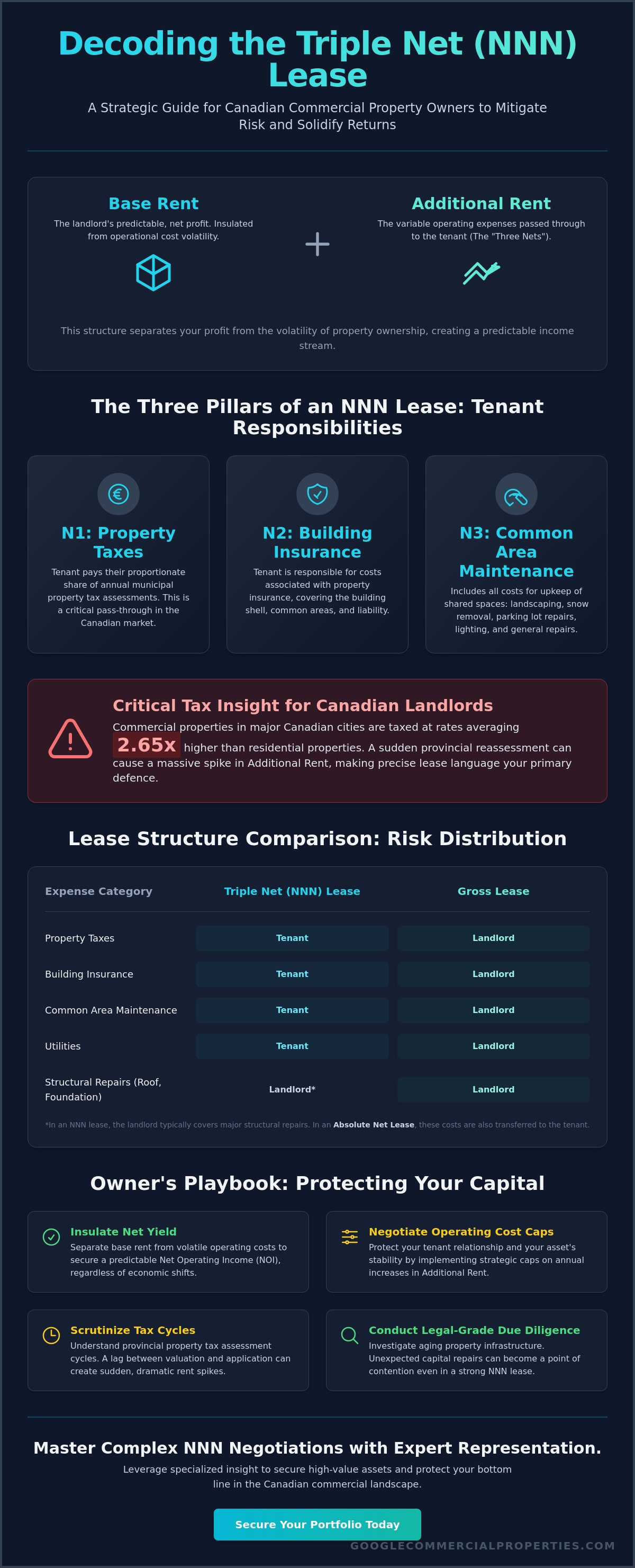
The core of this agreement lies in the distinction between Base Rent and Additional Rent. Base Rent is the fixed amount that remains net to you, the landlord. Additional Rent encompasses the property's operating expenses, which are passed through to the tenant. This transparency ensures you aren't guessing at your margins. The "Three Nets" specifically target the most volatile costs:
- Property Taxes: The tenant pays their proportionate share of annual municipal assessments.
- Building Insurance: Coverage requirements for the building shell, common areas, and liability.
- Common Area Maintenance (CAM): All costs for snow removal, landscaping, and general repairs.
The Legal-Adjacent Logic of Risk Distribution
A well-drafted Net lease acts as a shield for your Net Operating Income (NOI). By shifting the burden of inflation and rising taxes to the tenant, you ensure your cash flow remains consistent regardless of external economic shifts. Many investors confuse "Triple Net" with "Absolute Net." While NNN is robust, an Absolute Net lease is even more restrictive, often requiring the tenant to handle structural repairs like the roof and foundation. Choosing the right level of protection is a strategic decision that defines your long-term asset value. It's a solution-first approach to wealth preservation.
Canadian Commercial Real Estate Standards
Standardization is your ally in the Canadian market. Retail, industrial, and office sectors largely adhere to BOMA standards to define floor area and cost allocation. This uniformity allows for cleaner comparisons during investment property acquisition. However, you must realize the impact of provincial property tax assessment cycles. Across Canada, these cycles vary significantly. In some provinces, for example, there can be a substantial lag between property valuation and when those values are applied for tax purposes. This lag means a sudden reassessment, when it eventually occurs, could spike a tenant's Additional Rent, potentially impacting their ability to pay Base Rent. Precision in your lease language is the only way to manage these regional variables effectively.
The Three Pillars: Taxes, Insurance, and Maintenance Responsibilities
Execution in commercial real estate requires more than just capital; it demands a surgical precision in cost allocation. When you transition toward understanding triple net leases, you're essentially mastering the three pillars that support your Net Operating Income. These pillars; property taxes, building insurance, and common area maintenance (CAM); represent the variable costs that can erode profits if not managed with absolute transparency. By passing these through to the tenant, you secure a predictable yield while the tenant gains operational control over their environment.
Management fees also play a vital role here. These administrative costs cover the overhead of managing the billing and reconciliation process. While some landlords overlook these, a seasoned veteran knows that accounting for every dollar of administrative effort is essential for maintaining a truly net position. It's about ensuring your time is as protected as your capital.
The Property Tax Trap: Reassessments and Appeals
Property taxes represent the largest single expense in most Canadian commercial portfolios. Data from the Altus Group indicates that commercial properties in major cities are taxed at rates approximately 2.65 times higher than residential assets. This disparity makes the tax clause in your lease critical. In Ontario, for example, the 2026 tax year still relies on 2016 assessed values. A sudden provincial reassessment could trigger a massive spike in Additional Rent. While landlords typically retain the primary right to appeal, sophisticated tenants often negotiate for the right to contest assessments if the landlord chooses not to act. You should always define who carries the cost of these appeals to avoid friction during a reassessment cycle.
Insurance and Indemnification Clauses
Your building is your legacy. Protecting it requires ironclad insurance requirements that go beyond basic fire coverage. You must insist on being named as "additional insured" on the tenant’s policy to ensure you're covered by their liability limits. This isn't just a suggestion; it's a fundamental risk-management standard in the Types of Commercial Leases in Canada that protects your equity from third-party claims. In Canada, insurance premiums are typically reconciled annually by comparing the estimated monthly payments against the actual year-end invoice from the provider. A robust indemnification clause further isolates you from legal fallout resulting from the tenant's specific business operations.
CAM and the Maintenance Grey Area
CAM charges are often the most contested element of a lease agreement. You must clearly distinguish between "operating" maintenance, like snow removal or HVAC servicing, and "structural" capital expenditures. Most NNN leases leave the roof and foundation to the landlord, yet parking lot resurfacing often falls into a grey area. If you're looking to acquire a new asset, reviewing the history of these costs is vital during investment property acquisition due diligence. Transparency is the antidote to dispute. Providing an annual audit of CAM charges ensures that management fees and administrative costs are perceived as fair rather than hidden profit centres. It's about building a partnership based on proof of work and professional integrity.
NNN vs. Gross and Modified Leases: Choosing the Right Structure
Choosing the right lease structure is a high-stakes decision that dictates your long-term management burden. While the Gross Lease is often viewed as the "all-inclusive" model, it forces you to gamble on future operating costs. If property taxes or insurance premiums spike, your profit margin vanishes. Stepping up to Single Net (N) or Double Net (NN) leases offers partial relief, but only understanding triple net leases provides the total expense insulation required for institutional-grade stability. It's the difference between managing a building and managing an investment.
Modified Gross leases serve as a tactical middle ground, especially within the Canadian office sector. In this hybrid model, the landlord and tenant negotiate a "base year" for expenses. The tenant then pays for any increases above that baseline. This structure provides a safety net against inflation while remaining attractive to tenants who fear the total variable exposure of an NNN deal. High-net-worth investors consistently gravitate toward NNN structures. It's the gold standard for passive income; it allows you to focus on portfolio expansion rather than accounting for light bulbs and snow removal.
Comparative Risk Framework
Your choice of lease structure is often dictated by market leverage. In tight industrial markets like Vancouver or Toronto, where availability rates sat near 5.1% nationally in Q2 2025, landlords hold the power to demand NNN terms. From your perspective, NNN offers absolute cash flow predictability. For the tenant, the lower base rent is the hook, yet they face the risk of "sticker shock" if CAM costs spiral. Expert Commercial Leasing Services are essential here to ensure the lease type aligns with the asset's specific risk profile and current market demand.
Financial Impact Analysis
The lease structure directly influences your property's terminal value. NNN leases are highly favoured by lenders because they represent "clean" income with minimal landlord leakages. This often results in more favourable financing terms and compressed cap rates. For those involved in Franchise Resale Services or Restaurant and Hospitality Sales, the NNN structure is particularly critical. It allows a buyer to see the true operational efficiency of the business without it being clouded by fluctuating property expenses. When you realize the "true cost" of occupancy, you can price your assets with total confidence and precision.
Critical Risks and Negotiation Strategies for Owners
Precision is your only defense against the erosion of your Net Operating Income. While the NNN structure provides a robust shield against daily operating costs, aging infrastructure represents a latent threat to your capital that many investors overlook. You must look beyond the surface level of understanding triple net leases to identify exactly where capital replacements might bypass the CAM pass-through. If a roof requires a complete replacement rather than a simple patch, the cost often falls back on your shoulders unless your documentation is surgically precise. High-net-worth owners don't leave these details to chance; they treat lease drafting as a high-stakes engineering project.
Estoppel certificates are another non-negotiable tool in your risk-management arsenal, especially during a transition of ownership. These documents force the tenant to verify the current lease terms, outstanding balances, and any verbal agreements that might exist outside the written contract. Without a clean estoppel, you're flying blind into a potential dispute. Leveraging legal-adjacent expertise during the review of "additional rent" definitions ensures that every administrative fee and management cost is accounted for before the ink dries. Secure your next high-performing asset with a team that prioritizes precision in Investment Property Acquisition.
Negotiating the "Carve-Outs"
Strategic negotiation hinges on the precise definition of Common Area Maintenance. You should clearly exclude structural repairs, foundation work, and underground utilities from the tenant's obligations to maintain the asset's long-term marketability. Defining management fees as a fixed percentage of gross rent prevents claims of landlord overreach and establishes a transparent administrative baseline. A single, surgically defined clause in your lease document provides more long-term protection for your yield than a high headline rent price ever could. It's about creating a "solution-first" framework that anticipates conflict before it arises.
Due Diligence for NNN Acquisitions
Success in the Canadian commercial market is built on the rigorous audit of historical operating statements. You need to see exactly how costs have trended over the last five years to predict where future liabilities lie, particularly in regions prone to extreme weather. Environmental assessments are equally critical; you're inheriting the land's history along with its income. You must also realize the implications of termination and relocation clauses. A tenant with the right to exit early or move to a different unit can destabilize your financing and disrupt your exit strategy. Disciplined due diligence is the only way to ensure your passive income remains truly passive.
Navigating Complex NNN Negotiations with Expert Representation
Standard brokerage often falls short when the stakes involve multi-decade commitments and complex cost-recovery mechanisms. You need more than a middleman. You require a fierce advocate who treats your portfolio as a dedicated lifestyle. Understanding triple net leases at an institutional level means recognizing that every comma in a contract represents a potential financial leak. Grace Yan brings over 20 years of deep-rooted expertise in the Canadian market to ensure those leaks are sealed before they ever impact your balance sheet. By integrating a solution-first mindset into every negotiation, obstacles like anti-competitive exclusivity clauses or deferred maintenance disputes are reframed as opportunities for strategic resolution.
A successful NNN agreement isn't just about finding a tenant. It's about strategic alignment. Whether you're focused on Commercial Leasing Services or preparing for a high-yield exit through Commercial Property Sales, the quality of your lease document dictates your asset's terminal value. Expert representation ensures your tenant placement isn't just a transaction. It acts as a cornerstone of your long-term wealth preservation strategy. Mastering the nuances of understanding triple net leases with a seasoned veteran allows you to navigate the Canadian commercial market with absolute confidence.
The Grace Yan Advantage: Beyond the Transaction
Precision is a calling, not a job. Grace Yan’s paralegal background provides a unique, legal-adjacent lens through which she reviews every complex lease contract. This background allows for a level of due diligence that standard industry requirements simply don't cover. By combining this technical discipline with a global investment perspective, she secures favourable terms that reflect the true value of your holdings. It's a high-energy, high-achiever approach that places your interests in the hands of a professional who values transparency and proof of work above all else.
Next Steps for Your Commercial Portfolio
Your journey toward a more resilient portfolio starts with professional guidance. Whether you are actively seeking Investment Property Acquisition opportunities or need to optimize an existing asset for a future sale, the right strategy is paramount. We specialize in sourcing off-market NNN opportunities and refining lease structures to maximize cap rate compression across the Canadian landscape. Don't leave your yield to chance in an evolving market. Book a strategic consultation with Grace Yan Global Commercial Agent today.
Secure Your Portfolio's Future with Strategic Precision
You now possess the framework required to transform operational liabilities into a predictable, high-yield investment vehicle. By mastering the distribution of property taxes, insurance, and maintenance, you insulate your capital from the volatility inherent in the Canadian market. Understanding triple net leases is the first step toward achieving institutional-grade stability within your commercial portfolio. It's about shifting the burden of inflation and aging infrastructure away from your bottom line through surgically precise contract definitions.
Grace Yan leverages over 20 years of legal and real estate expertise to provide the former paralegal and Notary Public precision your high-stakes deals demand. As a global investment advisor with a national Canadian reach, she ensures your interests are protected by a fierce advocate who treats every transaction as a calling. Secure your commercial investment with an expert negotiation strategy; Contact Grace Yan today. Your next high-performing asset is within reach when you lead with expertise and unwavering confidence.
Frequently Asked Questions
What is the difference between an NNN lease and an Absolute Net lease?
An Absolute Net lease requires the tenant to assume every financial obligation; including structural integrity and building reconstruction; whereas a standard NNN lease typically reserves major structural repairs for the landlord. This distinction is vital for long-term capital planning. Investors seeking a truly hands-off, bond-like return prefer Absolute Net structures for their total insulation from property management and structural liabilities.
Can a tenant negotiate a cap on CAM charges in a Triple Net Lease?
Tenants frequently negotiate "caps" on controllable operating expenses like landscaping or janitorial services to prevent budget volatility. These caps usually exclude uncontrollable costs such as municipal property taxes or building insurance premiums. Establishing these limits during the initial negotiation creates a predictable framework that protects the tenant's cash flow while ensuring the landlord's net income remains stable and protected from management disputes.
Who is responsible for structural repairs in a standard Canadian NNN lease?
Landlords generally retain responsibility for structural components; including the roof, foundation, and exterior walls; in a standard Canadian NNN agreement. While the tenant covers operational maintenance and day-to-day repairs, the long-term integrity of the building shell remains the owner's obligation. Clear definitions in the lease are essential to prevent disputes over what constitutes a "repair" versus a "replacement" of aging infrastructure.
How are property taxes handled if a tenant only occupies part of the building?
Property taxes are distributed based on the tenant's proportionate share of the building's total Gross Leasable Area (GLA). If a tenant occupies 25% of the floor space, they are billed for exactly 25% of the annual municipal assessment. This calculation ensures a fair distribution of costs across multi-tenant centres and maintains transparency for all parties involved during the annual reconciliation process.
What happens if the actual operating costs are higher than the estimated budget?
Landlords perform a year-end reconciliation to compare estimated monthly payments against actual invoices received from service providers. If the actual operating costs exceed the budget, the tenant is responsible for paying the shortfall as a lump sum. Conversely, any overpayment results in a credit toward the following year's Additional Rent, ensuring the landlord remains in a net position regardless of cost fluctuations.
Is an NNN lease better for a small business or a large corporation?
Large corporations and credit tenants often prefer NNN structures because they offer lower base rents and greater control over their operational environment. Small businesses, however, may struggle with the "sticker shock" of fluctuating property tax assessments or insurance spikes. Understanding triple net leases helps owners determine if a tenant's financial profile can support the variable nature of these additional costs over a long-term term.
How does an NNN lease affect the resale value of a commercial property?
Resale value typically increases under an NNN structure because the income stream is "net" of all operating volatility. Lenders and institutional buyers value the predictability of a lease that shifts inflationary risks and rising municipal taxes to the tenant. This stability often leads to lower capitalization rates and higher valuations compared to properties with Gross lease structures where the owner bears the risk of rising costs.
What should I look for in the "Additional Rent" section of my lease agreement?
Review the "Additional Rent" section for precise definitions of what constitutes a recoverable expense versus a landlord's capital expenditure. You must examine the management fee percentage and ensure you have clear audit rights to verify annual reconciliations. Mastery in understanding triple net leases involves identifying hidden administrative markups that could lead to tenant friction if not clearly disclosed and justified within the contract.